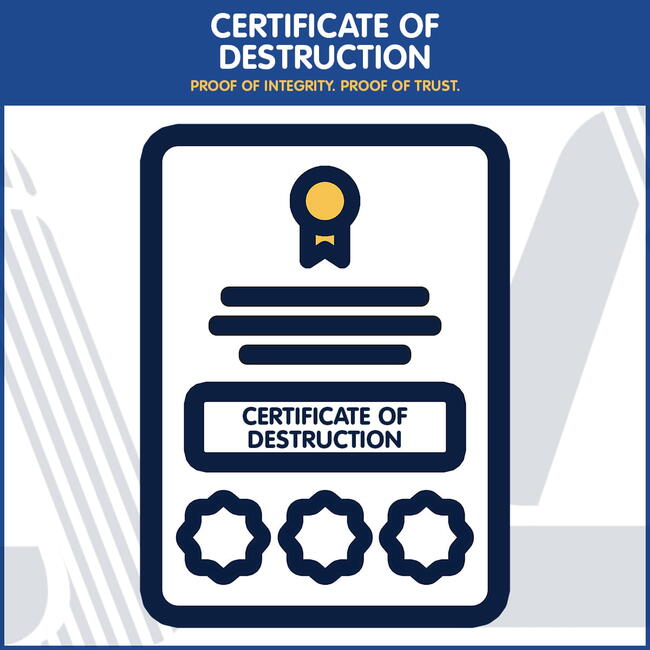
A Certificate of Destruction (CoD) is one of the most important documents in secure disposal, compliance, and risk management. Whether you’re destroying sensitive documents, electronic media, prototypes, or regulated waste, a Certificate of Destruction document provides formal proof that materials were permanently and irreversibly destroyed according to industry and regulatory standards.
In other words, a CoD is the final step in the chain of custody process. It verifies that the items you intended to destroy were actually destroyed and that the destruction was performed in a compliant, documented, and auditable manner.
What Is a Certificate of Destruction?
A Certificate of Destruction is an official document issued by a certified destruction vendor. It confirms that specific materials have been collected, processed, and destroyed using approved methods. Organizations rely on this document to demonstrate compliance with privacy laws, environmental regulations, and internal security policies.
Businesses in industries such as healthcare, finance, manufacturing, and technology often require a Certificate of Destruction to meet strict regulatory obligations under HIPAA, FACTA, GLBA, SOX, and GDPR.
Required Fields in a Certificate of Destruction
A legally defensible Certificate of Destruction document must include several key fields. These details ensure the destruction event can be verified, audited, and traced back through the chain of custody.
- Date of Destruction — The exact date the materials were destroyed. This timestamp is essential for audits, retention schedules, and regulatory reporting.
- Description and Weight — A clear description of the items destroyed (documents, hard drives, media, product samples) and the total weight or quantity. Weight helps validate chain‑of‑custody accuracy and environmental reporting.
- Destruction Method — The specific method used, such as shredding, pulverizing, incineration, degaussing, or certified digital wiping. This confirms compliance with industry and regulatory standards.
- Witness or Authorized Signatory — A signature from a qualified witness or destruction technician, legally attesting that the destruction occurred as documented.
- Vendor Information — The destruction provider’s name, address, contact information, and certification details (e.g., NAID AAA).
- Tracking or Serial Numbers — Bin IDs, box numbers, media serial numbers, or batch identifiers that maintain chain‑of‑custody integrity.
- Statement of Irreversible Destruction — A formal declaration that the materials cannot be reconstructed, recovered, or reused.
Together, these fields create a defensible record that stands up to audits, legal scrutiny, and compliance reviews.
Why Certificates of Destruction Matter
Destroying materials isn’t just about eliminating physical items — it’s about eliminating risk. A Certificate of Destruction protects your organization by proving that sensitive or regulated materials were handled correctly.
1. Legal Protection
A CoD provides documented evidence that your organization followed required disposal procedures. In cases of litigation, regulatory inquiry, or data breach investigation, this document becomes critical proof of due diligence.
2. Regulatory Compliance
Industries governed by strict privacy and data‑security laws must prove that sensitive information was disposed of properly. A Certificate of Destruction is often the only accepted proof of compliant destruction.
3. Chain‑of‑Custody Integrity
The destruction process often includes collection, transport, storage, and processing. A CoD closes the chain of custody with a timestamped, witnessed, and fully documented endpoint.
4. Audit Readiness
Auditors frequently request destruction records. A Certificate of Destruction provides a standardized, easy‑to‑file document that satisfies audit requirements without scrambling for evidence.
5. Risk Reduction & Peace of Mind
Being able to prove that sensitive materials were destroyed reduces exposure to data breaches, identity theft, intellectual property loss, and compliance penalties.
6. Vendor Accountability
A CoD ensures the destruction vendor is legally responsible for the destruction event. Without it, organizations have no proof that destruction actually occurred.
Why Organizations Value Certificates of Destruction
A Certificate of Destruction document is more than a form — it’s a risk‑management asset. It protects your brand, reduces liability, supports compliance frameworks, and provides a defensible record of responsible stewardship over sensitive information.
If your organization handles confidential materials, prototypes, or regulated waste, a Certificate of Destruction is essential for proving secure and compliant disposal.
Ready to Prove Your Product Was Properly Destroyed?
Partner with Pacific Materials Destruction for secure, verified product destruction that protects your brand, your customers, and your reputation.