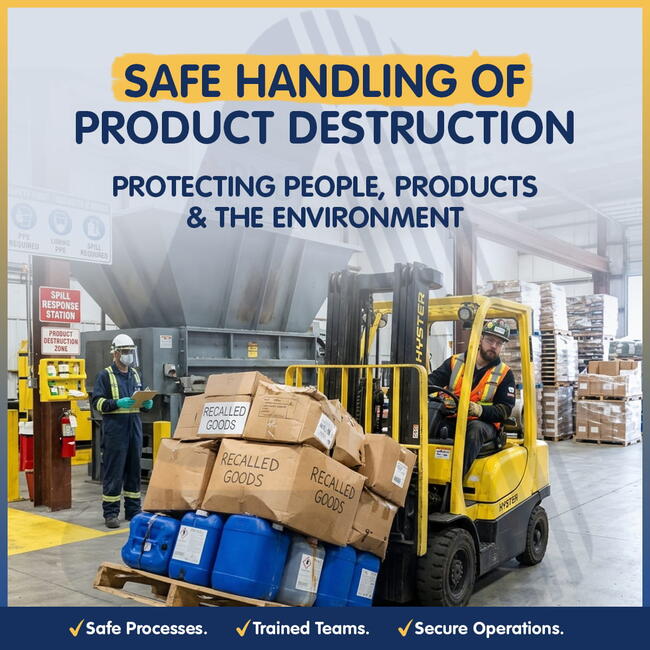
Best Practices for Secure and Compliant Destruction Services
Safety is a priority when handling materials destined for Product Destruction services.
Materials for the need to be destroyed often arrive in less-than-perfect condition. They may have been damaged during manufacturing, transportation, storage, or distribution and are no longer suitable for sale or customer use. While these products require complete destruction to protect brands and consumers, they must also be managed with strict safety protocols to minimize risks to employees, the environment, and surrounding operations.
At Pacific Materials Destruction (PMD), safe handling is the foundation of every product destruction project. Whether managing damaged consumer goods, recalled products, expired inventory, defective merchandise, packaging waste, or confidential branded items, our team follows proven procedures and industry-leading safety standards to ensure secure and efficient destruction.
PMD is trained in handling pallets and products that require destruction. We utilize specialized equipment, including heavy-duty forklifts with rotating fork capabilities, skid steers, spill response kits, and a wide range of personal protective equipment (PPE) to safely manage inbound materials. Our team undergoes continuous safety training and follows detailed handling procedures to ensure all materials are processed safely and efficiently.
An additional component of our safety-focused approach involves a preventative maintenance program that ensures all equipment operates properly and reliably. PMD maintains a dedicated maintenance team responsible for identifying, repairing, and preventing equipment deficiencies before they affect operations.
Why Safe Handling Matters in Product Destruction
Product destruction is far more complex than simply disposing of unwanted goods. Products arriving for destruction may present various risks, including:
- Broken packaging
- Leaking liquids
- Unstable pallet loads
- Contaminated materials
- Damaged containers
- Sharp objects
- Chemical exposure risks
- Fire hazards
- Environmental concerns
Without proper handling procedures, these hazards can create dangerous conditions for workers and increase liability for businesses.
According to guidance from the Canadian Centre for Occupational Health and Safety (CCOHS), proper hazard identification, risk assessment, employee training, and equipment maintenance are critical components of workplace safety programs across Canadian industries. These principles are especially relevant in product destruction environments where damaged and unpredictable materials are commonly encountered.
Organizations that prioritize safe product destruction benefit from:
- Reduced workplace injuries
- Improved operational efficiency
- Regulatory compliance
- Environmental protection
- Lower insurance risks
- Stronger brand protection
- Reduced downtime
Safety should always be a primary evaluation factor when selecting a destruction partner.
Understanding the Challenges of Handling Damaged Products
Many products entering destruction facilities have experienced some form of failure before arrival. Common points of failures may include:
Transportation Damage
Products can shift during transport, resulting in crushed pallets, broken packaging, and unstable loads. These damaged shipments often require specialized unloading procedures.
Manufacturing Defects
Products recalled due to quality concerns or defects often require complete destruction to prevent accidental redistribution.
Expired Goods
Food, beverages, pharmaceuticals, cosmetics, and consumer products may deteriorate over time, creating additional handling and safety concerns.
Environmental Exposure
Materials exposed to excessive heat, moisture, freezing temperatures, or contamination may become unstable and require additional precautions during destruction.
Each of these scenarios requires specific handling protocols and trained personnel to ensure that products are processed safely and efficiently.
Specialized Equipment for Safe Product Destruction
One significant factor that differentiates professional destruction providers from general waste handlers is access to specialized equipment.
At Pacific Materials Destruction dedicated equipment helps minimize risks while improving productivity.
Heavy-Duty Forklifts with Rotating Forks
Damaged pallets often arrive leaning, collapsed, or partially broken. Traditional forklifts may struggle to safely move these loads.
Heavy-duty forklifts equipped with rotating fork attachments allow operators to:
- Stabilize compromised loads
- Safely reposition damaged pallets
- Reduce product spills
- Improve unloading efficiency
- Minimize worker exposure to hazards
This level of equipment specialization significantly improves safety while reducing processing times.
Skid Steers
Skid steers provide flexibility for handling various product types and debris removal activities within destruction facilities. Their compact design allows operators to:
- Move damaged materials quickly
- Manage waste streams efficiently
- Transport bulk products safely
- Support site cleanup operations
Spill Response Equipment
Some products entering destruction facilities contain liquids, oils, cleaning solutions, chemicals, or food-grade materials. Immediate spill containment is an important aspect of safe product destruction operations. PMD maintains spill response kits designed to:
- Contain accidental releases
- Protect workers
- Prevent environmental contamination
- Support regulatory compliance
- Reduce cleanup times
The Critical Role of Personal Protective Equipment (PPE)
Personal Protective Equipment forms another essential layer of protection for employees working in product destruction environments.
Canadian workplace safety standards consistently emphasize PPE as a key element of hazard control when engineering and administrative controls alone cannot eliminate risks.
A comprehensive PPE program ensures workers remain protected throughout all handling and destruction activities. Depending on the materials being processed, workers may utilize:
- Safety glasses
- Face shields
- Cut-resistant gloves
- Steel-toe boots
- Respiratory protection
- High-visibility clothing
- Protective coveralls
- Hearing protection
Employee Training: The Foundation of Safe Operations
Equipment alone does not create a safe workplace. Properly trained employees are equally important.
Pacific Materials Destruction invests heavily in ongoing workforce development to ensure team members remain prepared for a wide variety of handling scenarios.
Weekly Safety Training
Weekly safety sessions help reinforce critical safety procedures while addressing new risks and operational challenges. Regular safety meetings encourage communication and create a proactive safety culture. Topics may include:
- Safe forklift operation
- Hazard communication
- Load stability assessment
- Spill response procedures
- Emergency response planning
- Incident prevention
- PPE requirements
- Material handling techniques
Real-World Scenario Training
Practical training exercises allow employees to experience realistic handling situations before they occur in live operations. Hands-on training helps employees respond more confidently and safely when challenges arise. Examples include:
- Collapsed pallet recovery
- Hazardous spill containment
- Emergency evacuation procedures
- Equipment malfunction response
- Product recall handling
Communication and Team Coordination
Many workplace incidents result from communication breakdowns rather than equipment failures. Strong communication systems support both safety and productivity. Clear communication protocols help employees:
- Understand hazards
- Coordinate equipment movement
- Report safety concerns
- Escalate incidents quickly
- Minimize confusion during high-risk operations
Preventative Maintenance: An Often Overlooked Safety Tool
One of the most effective ways to improve workplace safety is through preventative maintenance.
Equipment failures create significant risks in product destruction facilities where large volumes of materials are constantly being moved and processed.
PMD's preventative maintenance program is designed to identify potential problems before they create safety hazards.
Benefits of Preventative Maintenance
Regular servicing of forklifts, skid steers, conveyors, destruction equipment, and related machinery ensures it is properly functioning at all times. Routine inspections and maintenance provide numerous advantages:
- Reduced equipment downtime
- Improved reliability
- Safer operation
- Longer equipment life
- Reduced repair costs
- Increased productivity
Dedicated Maintenance Team
When equipment is properly maintained, both safety and efficiency improve. PMD maintains an assigned maintenance team responsible for monitoring equipment performance and addressing deficiencies quickly. This proactive approach helps avoid:
- Mechanical failures
- Operational delays
- Safety incidents
- Unexpected repair costs
Compliance and Regulatory Considerations in Canada
Canadian businesses face increasing pressure to ensure products are destroyed responsibly and securely. Working with an experienced destruction partner helps reduce compliance risks while ensuring products are permanently removed from circulation.
Industries commonly requiring secure destruction include:
- Retail
- Food and beverage
- Manufacturing
- Consumer packaged goods
- Healthcare
- Pharmaceuticals
- Electronics
- Logistics
Proper destruction processes help organizations maintain compliance while protecting customers and brand reputation.
Canadian companies must also consider:
- Occupational health and safety regulations
- Environmental protection requirements
- Waste management regulations
- Product recall obligations
- Brand protection standards
Protecting Brands Through Safe Product Destruction
Beyond safety and compliance, product destruction serves as an important brand protection function. By ensuring complete and secure destruction, businesses can confidently eliminate risk while protecting their reputation.
Products that are damaged, expired, recalled, or defective can seriously impact customer trust, if they re-enter the marketplace.
Professional destruction procedures help prevent:
- Unauthorized resale
- Counterfeit substitution
- Product diversion
- Brand reputation damage
- Consumer safety incidents
Environmental Responsibility and Product Destruction
Whenever possible, product destruction providers should seek environmentally responsible disposal and recycling options while maintaining destruction integrity.
As highlighted by Canadian environmental initiatives and waste reduction programs, businesses are increasingly focused on reducing landfill impact and improving sustainability practices.
Safe handling contributes to environmental performance by:
- Preventing spills and contamination
- Improving recycling opportunities
- Supporting waste segregation
- Reducing environmental incidents
- Enhancing material recovery rates
Why Experience Matters in Product Destruction Services
Not all destruction providers possess the expertise required to handle damaged, unstable, or high-risk materials safely.
An experienced provider offers:
- Trained personnel
- Specialized equipment
- Comprehensive safety programs
- Regulatory knowledge
- Documented destruction processes
- Secure chain-of-custody procedures
When evaluating a product destruction partner, organizations should carefully assess the provider's safety systems, employee training programs, maintenance practices, and operational capabilities.
These factors directly influence service quality, project efficiency, and overall risk management.
The Pacific Materials Destruction Advantage
Pacific Materials Destruction has built its reputation on safety, compliance, efficiency, and security.
Our approach combines:
- Extensive employee training
- Weekly safety education
- Real-world scenario preparation
- Specialized destruction equipment
- Advanced material handling capabilities
- Spill response preparedness
- Personal protective equipment programs
- Preventative maintenance systems
- Dedicated maintenance personnel
This integrated approach ensures that every product destruction project is completed safely, securely, and efficiently.
Whether handling damaged inventory, recalled products, expired goods, or confidential brand-sensitive materials, PMD delivers professional destruction solutions that protect people, brands, and the environment.
You Found Your Partner: Ask for a Quote Today
If your organizhttps://open-form=1ation requires safe, secure, and compliant product destruction services anywhere throughout British Columbia, trust the experienced team at Pacific Materials Destruction.
Learn more about our product destruction capabilities, request a quote, or speak with our team about your specific destruction requirements. Protect your brand, ensure compliance, and partner with a company that puts safety first.
At Pacific Materials Destruction, safety is not simply a requirement; it is part of every process, every project, and every decision. Our commitment to safe handling ensures that products are destroyed securely while protecting employees, clients, and the environment.
Frequently Asked Questions (FAQ)
What is product destruction?
Product destruction is the controlled process of permanently destroying products that are damaged, recalled, defective, expired, counterfeit, or otherwise unsuitable for sale or distribution.
Why is safe handling important during product destruction?
Safe handling reduces the risk of workplace injuries, environmental incidents, product spills, and equipment damage while ensuring compliance with applicable regulations.
What types of products require destruction services?
Common products include recalled consumer goods, expired food products, defective merchandise, pharmaceuticals, cosmetics, electronics, branded materials, and surplus inventory.
What equipment is commonly used in product destruction?
Professional product destruction facilities often utilize forklifts, rotating fork attachments, skid steers, conveyors, shredders, compactors, spill response equipment, and personal protective equipment.
How does preventative maintenance improve safety?
Preventative maintenance helps identify equipment issues before they become hazards, reducing breakdowns, improving reliability, and creating a safer work environment.
How does product destruction protect a company's brand?
Secure destruction prevents unauthorized resale, diversion, counterfeiting, and accidental re-entry of defective products into the marketplace, helping maintain customer trust and brand integrity.
Is product destruction environmentally responsible?
When managed properly, product destruction can support recycling, waste diversion, material recovery, and environmental compliance while ensuring products are fully removed from circulation.
Why choose Pacific Materials Destruction?
Pacific Materials Destruction provides specialized equipment, trained personnel, robust safety programs, preventative maintenance systems, and secure destruction processes designed to protect your products, brand, employees, and the environment.