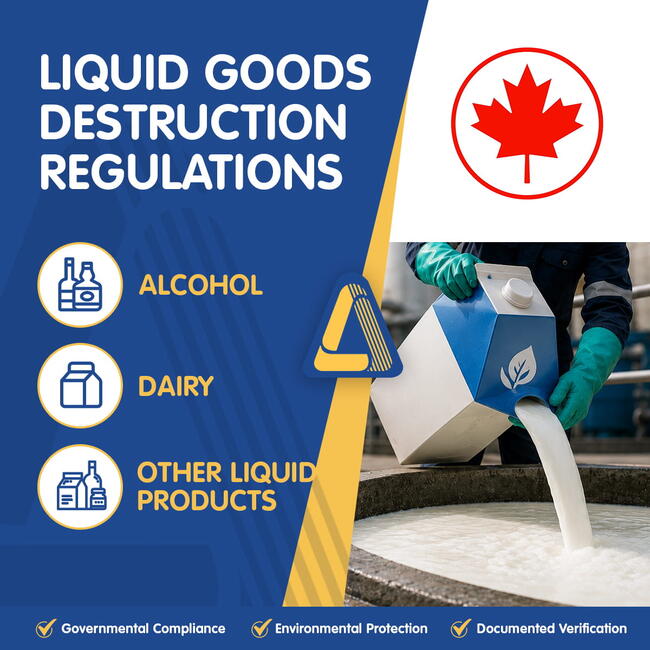
Businesses across Canada that manufacture, distribute, or store regulated liquid products—such as alcohol, dairy, and other consumable goods—must follow strict federal and provincial rules when destroying expired, contaminated, or unsellable inventory.
This guide breaks down the essential CRA regulations, documentation requirements, and compliance steps for destroying alcohol, dairy, and other liquid goods in Canada.
Alcohol Product Destruction Regulations
Alcohol is tightly regulated in Canada due to excise tax liability and diversion risks. Proper destruction protects public safety, prevents diversion, and ensures compliance with the Canada Revenue Agency (CRA) under the Excise Act, 2001, as well as food safety and environmental regulations.
Under the Excise Act, 2001, producers, licensees, and excise warehouse operators must follow specific procedures when destroying alcohol products.
Key Requirements for Alcohol Destruction
- Advance notification to CRA Excise licensees must notify CRA before destroying alcohol that is subject to excise duty. The notice typically includes:
- Reason for destruction
- Date, time, and location
- Quantity and type of alcohol
- Method of destruction
CRA may require additional details depending on the product type and tax status.
- Supervision or Verification - CRA may choose to supervise the destruction or require proof afterward. If CRA does not attend, destruction may proceed, but documentation must be complete and accurate.
- Recordkeeping Requirements - Licensees must maintain permanent records showing and records must be available for audit:
- The quantity destroyed
- The person or company who performed the destruction
- Evidence of destruction (photos, certificates, logs)
- Any CRA correspondence
Recovered Alcohol Rules
Manufacturers who recover alcohol during production, such as distillation byproducts or reclaimed spirits, must follow additional CRA rules:
- Recovered alcohol cannot be sold or transferred without CRA authorization.
- Destruction of recovered alcohol requires prior notice and may require CRA approval depending on volume and tax status.
- CRA may impose conditions such as:
- Requiring a witness
- Mandating specific destruction methods
- Additional reporting
Recovered alcohol remains subject to excise control until CRA confirms destruction or approves another disposition.
Dairy Disposal Requirements
Dairy products are regulated under CFIA (Canadian Food Inspection Agency), Health Canada, and provincial environmental agencies. While CRA does not regulate dairy, destruction must comply with food safety and environmental standards.
Common Dairy Destruction Compliance Steps in Canada
- Preventing Environmental Contamination Dairy - Waste has high biological oxygen demand (BOD) and can harm waterways. Disposal must follow:
- Municipal wastewater bylaws
- Provincial environmental regulations
- Permitted discharge limits
- Following Provincial Agricultural Rules - Provinces may require permits for large‑scale dairy disposal due to pathogen, nutrient, and odour concerns.
- Using Approved Destruction Methods - Depending on the product type, acceptable methods may include:
- Land application under nutrient management rules
- Anaerobic digestion
- Composting
- Rendering
- Licensed waste destruction facilities
Liquid Goods Destruction Compliance in Cananda
Other liquid goods, such as beverages, syrups, chemicals, and wash water, may fall under CRA excise rules, CFIA food safety rules, or provincial environmental regulations.
Chemical & Liquid Byproduct Rules (CRA)
Under the Excise Act, 2001:
- Liquids removed from excise‑controlled premises must be free of alcohol unless CRA approves otherwise.
- Wastewater containing alcohol may be destroyed or disposed of on‑site, provided alcohol content is documented, and its disposal complies with environmental regulations.
- Records must be kept for testing results, removal quantities and destruction methods.
Best Practices for Compliant Liquid Goods Destruction
1. Document Everything
Businesses should maintain detailed logs that clearly record the quantities of liquid goods destroyed, the specific destruction methods used, the personnel or third‑party vendors involved, and any notices submitted to the Canada Revenue Agency (CRA) or provincial authorities. Keeping thorough documentation ensures traceability and supports compliance during audits.
2. Use Approved Destruction Methods
Liquid goods must be destroyed using methods that meet Canadian regulatory standards. Depending on the product type, compliant destruction may involve denaturing the material, incinerating it, chemically neutralizing it, treating it through approved wastewater systems, or carrying out supervised on‑site destruction. Each method must be appropriate for the product and compliant with environmental and excise requirements.
3. Work With Certified Destruction Vendors
Partnering with certified destruction vendors helps ensure that all regulatory obligations are met. Professional destruction companies provide full chain‑of‑custody documentation, maintain compliance with federal and provincial regulations, manage secure transportation and disposal, and issue certificates of destruction that serve as official proof for CRA and environmental authorities.
4. Follow Environmental Regulations
Businesses must comply with all applicable provincial and municipal environmental regulations when destroying liquid goods. Depending on the nature of the materials, authorities may require discharge permits, adherence to hazardous waste handling procedures, or the implementation of spill‑prevention plans. Meeting these requirements protects the environment and ensures lawful disposal practices.
Why Proper Liquid Goods Destruction Matters
Following CRA and Canadian environmental rules helps businesses:
- Avoid fines and enforcement actions
- Prevent illegal diversion of alcohol or consumable goods
- Protect public health and the environment
- Maintain compliance during CRA audits
Alcohol, dairy, and liquid goods destruction in Canada requires careful planning, documentation, and compliance with CRA excise rules, CFIA food safety standards, and provincial environmental regulations.
By understanding these requirements and implementing strong internal controls, businesses can safely and legally dispose of regulated liquid products.
Looking for experts in compliant liquid goods destruction? Connect with a Pacific Materials Destruction specialists to get a customized quote for secure, CRA‑aligned product disposal today.